+36 20 351 4717
H-3580 Tiszaújváros, Teleki Blanka u. 4.

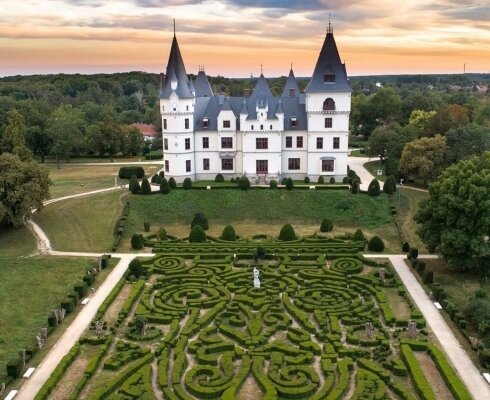
A trip to the Andrássy Castle of Tiszadob...
The castle was built at the request of Gyula Andrássy Sr., the first Minister of Foreign Affairs of the Austro-Hungarian Monarchy, between 1880-1885. The building was designed by Arthur Meinig, who had been inspired by medieval knights’ castles along the French river Loire.
A peculiarity of the building is that it has four entrances according to the number of seasons, 12 turrets according to the number of months, 52 rooms according to the number of weeks and 365 quarrels according to 365 days in a year. The multi-turret building bears neo-Gothic and romantic stylistic features.
The main entrance of the building opens into the main staircase, in which stairs with beautiful oak railings and tracery lead up to the second floor. From the main staircase, a large four-winged glass door opens to the former knight hall. In the middle of this rectangular room covered with rib-vaulted Gothic ceiling, there is a huge stone fireplace, decorated with the carved coat of arms of the Andrássy family.
This room opens to a row of halls where the permanent exhibition presenting the everyday life of the Andrássy family is housed. The perfectly restored rooms furnished with contemporary furniture and equipment include the stately grand parlour, the count’s study, the music parlour, the library, the bedrooms of the count’s family, the schoolroom of the count’s daughters and the emblematic turret room of Katinka Andrássy.
The castle was built close to the river Tisza, therefore, it stands out from the floodplain of the river.
According to contemporary taste, in front of the facade of the building, a separate front park was created. The clipped boxwoods formed a medieval lily. In the middle of the huge clipped hedge labyrinth, visitors can admire a sculpture by János Fadrusz, called Daughter Elopement. In the 1880s, a landscape-garden, which has been well-looked-after since then, was established behind the castle. In the east, the park is bordered by the river Tisza itself.